
Description
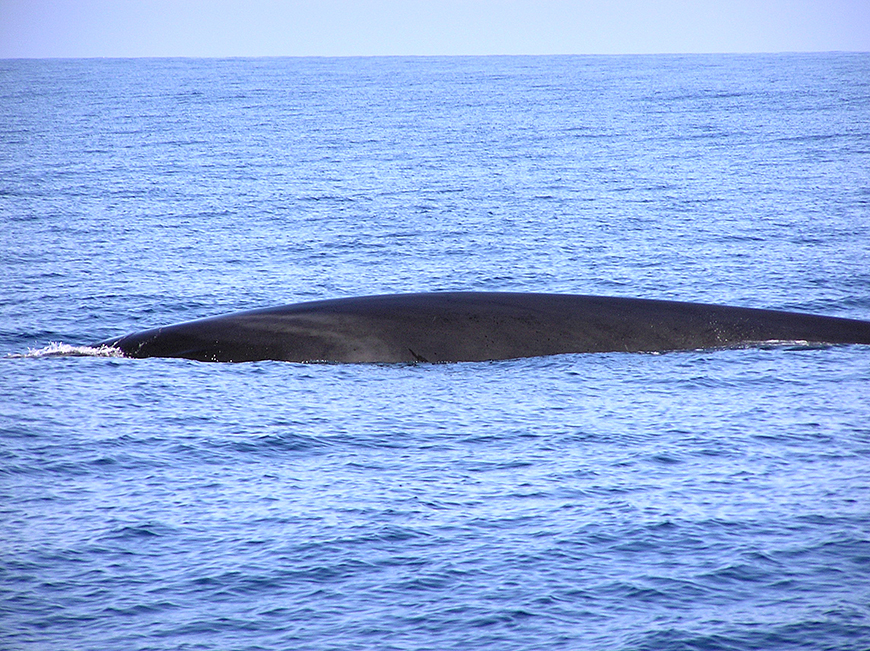
The common whale can reach up to 25 meters in length, but measures on average between 19 and 20 meters. Its body is grayish, and the lower part is whitish. It has a very long, pointed and flat snout and a pair of blowholes on top of its head. Typically this whale has a white mark on the right of its jaw, which makes it easy to identify. However, it is not yet clear why this feature is present.
Its dorsal fin is three-quarters of the way down its back and it usually has a “crooked” posture, with its back curving from the fin to the tail.
Behavior
The common whale is categorized as a filter-feeder, that is, it practices filter-feeding by consuming food particles that are suspended in the water column, passing water through a filtering structure and retaining the food. In the case of the common whale, this structure is its “baleen” or whale baleen. These are long flexible plates of keratin, located in the whale’s upper jaw. An adult common whale has between 260 and 470 whale baleen on each side of its mouth. Thus, its diet consists of small shoals, squid, and small crustaceans.
Nicknamed the “greyhound of the deep,” the Fin Whale can reach speeds of over 40 kilometers per hour.
As is common with whales, this species is extremely social and lives in groups of 6 to 10 individuals.
Distribution
The common whale inhabits all the world’s main waters, with the exception of waters near the North and South Poles.
Where to find and watch
The activity of whale watching is gaining more and more popularity, being one of the most requested activities in the Azores. It is possible to observe the common whale in the Azores, mainly during the spring months.
Conservation status
Although highly regulated, whaling is legal in some countries, for example Greenland.
The common whale is endangered mostly due to overhunting during the early to mid 19th century.
Photographs: SIARAM (ImagDOP©ImagDOP/UAz) |