Only considered a species in 2008, the Paínho-de-Monteiro is a pelagic bird endemic to the Azores, and its entire population nidifies only on the islets bordering Graciosa island.
Description
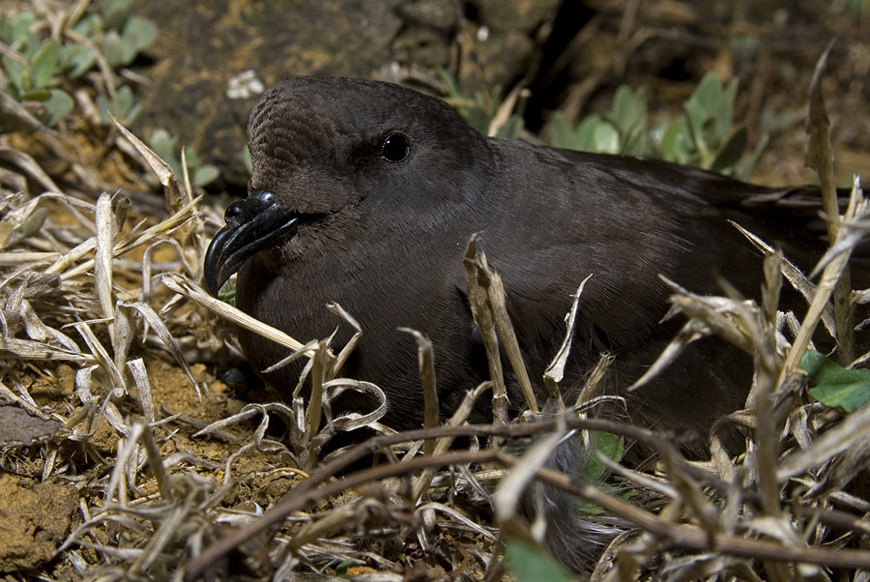
Hydrobates moneteiroi is a small bird, being the smallest seabird of the Azores. Its size varies between 18-20 cm in length and 35-60 g in weight. It has a dark color throughout its body, with the exception of its uropygium (area where the tail feathers are inserted), which is white or grayish.
Behavior
It is speculated that the Paínho-de-Monteiro inhabits most of the islets that surround Graciosa island, as well as Flores island. However, nesting has only been confirmed on the Praia and Baixo Islet of Graciosa island.
The Paínho-de-Monteiro reaches breeding age at 2 years of age and is capable of living up to its 20th year.
Typically its diet is based on small fish and squid, and this bird dives only a few centimeters to hunt. In the past, during whaling season, the Paínho-de-Monteiro was often seen feeding on the remains of whale carcasses.
History
The recognition of the Paínho-de-Monteiro as a species originated from the studies of Luís Rocha Monteiro, then a researcher, during his PhD. He verified that the two seasonal forms of the Paínho-da-Madeira (Paínho-da-Madeira-de-época-quente and Paínho-da-Madeira-de-época-fria) presented several different behaviors and characteristics. The morphology and diet of the Paínho-da-Madeira-de-época-quente differed from that of the Paínho-da-Madeira-de-época-fria, although they were recognized as seasonalities of the same species. From here, studies were conducted to prove the genetic difference between the two, leading to the consideration of the Paínho-da-Madeira-de-época-quente as a distinct species. Thus, it was named Paínho-de-Monteiro, in honor of Dr. Luís Monteiro, who had tragically died in a plane crash in 1999.
In 2021 the Paínho-de-Monteiro was elected Bird of the Year, as the result of an online vote. This “contest” was the result of an effort by the Portuguese Society for the Study of Birds (Sociedade Portuguesa para o Estudo de Aves) to raise awareness about this curious endemic Azorean species.
Conservation status
Due to its unique nesting site, it is currently in a vulnerable state, with numbers between 250 and 300 pairs. Humans do not constitute a major threat to the Paínho-de-Monteiro, since this bird nests in places of difficult access. Thus, its main threats are small mammals such as mice and cats, and also birds of prey.
Over the years several initiatives have been undertaken to protect and conserve this species, such as the construction of artificial nests.
Where to find and observe
It can be seen only at sea, and is more frequent between the months of April and September, on the north coast of the island and near Islet de Baixo in the southeast part of the island.
(all images used belong to SIARAM | siaram@azores.gov.pt | Paulo Henrique Silva | paulo.hg.silva@azores.gov.pt)